


Categories
- News (236)
- Support (262)
- OEM & ODM (10)
- Drivers & Tools (10)
- Instructions (29)
- Troubleshooting (44)
- Knowledge (97)
- Maintainance (8)
- Blog (89)
Wireless POS machines refer to wireless communication technologies such as cellular data and WiFi to achieve transaction data transmission and verification with bank card acquiring institutions, and complete fund settlement, with high mobility and flexibility.
Wireless POS machines are deployed faster. They usually do not require wiring or installing sockets. Just set up an appropriate wireless network, and the wireless POS machine can connect and start working immediately, which can effectively reduce costs.
With the popularization of 5G networks and the acceleration of wifi, more and more POS software choose to store data in the cloud, making the application of wireless POS machines more abundant.
Both cellular data and WiFi can provide a certain distance of coverage, allowing wireless POS machines to be operated without being fixed on the counter. Some lightweight wireless POS machines can also be taken directly to customers for ordering and checkout, reducing queues and improving checkout efficiency. In actual use, wireless devices such as thermal printers and barcode scanners can also be connected via wifi or Bluetooth to reduce the cumbersome cabling and achieve long-distance data transmission.
Moreover, the cellular data version of the wireless POS machine can also be used in mobile food trucks, exhibitions, and pop-up stores, which enhances flexibility and multi-scenario applicability.
However, you need to pay attention to security and stability when using wireless POS machines. Sunany suggested that appropriate security measures can be taken to protect wireless connections from unauthorized access and data leakage. In addition, ensuring the stability and reliability of the wireless network is also critical.
 Before a POS SSD Replacement, Prepare the Software Restore
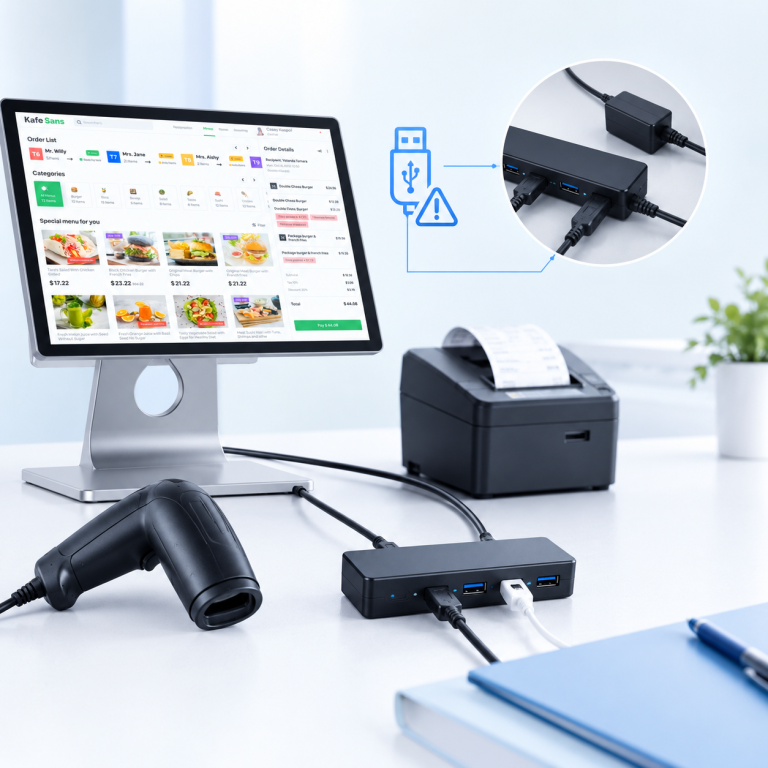 A Simple USB Hub Test for POS Device Disconnections
 Why Is Your POS Cash Drawer Not Opening
 Why Is a Thermal Receipt Printer Printing Blank Receipts
 What to Record When a Retail Checkout Terminal Restarts