


Categories
- News (236)
- Support (262)
- OEM & ODM (10)
- Drivers & Tools (10)
- Instructions (29)
- Troubleshooting (44)
- Knowledge (97)
- Maintainance (8)
- Blog (90)
In Intel’s ever-evolving line of processors, the N95 and N97 are frequently employed by POS terminal PC Windows manufacturers, and they have achieved good results in performance and energy efficiency. In order to better help everyone choose a processor that suits them, let’s take a look at the differences between the two with Sunany today.
The Intel N95 processor (sometimes referred to as Celeron N95 or Pentium N95) is built on Intel’s 7-process technology, ensuring a balance between performance and power efficiency. It features 4 cores and 4 threads, with a turbo frequency of 3.4 GHz, and all cores can access up to 6 MB of L3 cache. In addition, the TPD of the processor N95 is 15w, which means that the N95 may generate more heat when processing high-load tasks.
As an entry-level mobile CPU, the N97 model has no performance cores and only provides 4 of the 8 high-efficiency cores (E cores, Gracemont architecture), with a maximum turbo frequency of 3.60GHz and supports 6 MB Intel Smart Cache. The TPD of the processor N97 is 12w. The lower power consumption means that the processor N97 is more energy-efficient and generates less heat during long-term operation, which helps to extend the service life of the POS terminal PC Windows.
From the technical specifications, we know that POS terminal PC Windows based on the processor N95 can better handle complex tasks, such as running cash register systems, inventory management, and customer relationship management (CRM) at the same time. For POS terminal PC Windows, which only needs to perform basic daily tasks, such as transaction processing, printing receipts, simple inventory management, and customer data entry, the processor N97 is more suitable.
In addition to managing sales and inventory, POS terminal PC Windows often displays advertisements and customer interaction interfaces. Both the N95 and N97 are equipped with integrated graphics based on Intel’s Xe architecture. The N95 offers 16 out of 32 EUs (Execution Units), operating at a frequency of 1200 MHz. The N97 provides 24 of the 32 EUs (execution units) at a running frequency of 1200 MHz. Although the running frequency is the same, the N97 has more execution units, so the POS terminal PC Windows based on the processor N97 will run more smoothly when playing high-definition advertising videos and displaying complex graphical interfaces. However, if the POS terminal PC Windows only displays a simple cashier interface and static product images, the N95 is more suitable.
Whether it is a POS terminal PC Windows based on the processor N95 or the processor N97, in order to better connect with peripheral devices such as printers, barcode scanners, and monitors, it is equipped with common interfaces such as USB, HDMI, VGA, Ethernet, and some are also equipped with additional PCIe slots or M.2 slots. As a subsequent product processor launched by Intel, the N97 may support more USB ports, a higher version of the HDMI interface, or a more advanced network interface, but the specific number and interface type will also vary depending on the manufacturer’s product design.
All in all, N95 belongs to Intel’s mobile product family, and N97 belongs to Intel’s embedded product family. It seems that N97 is more suitable for POS terminal PC Windows that need to run for a long time. Sunany provides multiple POS terminal PC Windows based on N97 processors, including the F series, A series, T series, and the new E series. They are all very suitable for use in the retail industry.
 DDR4 vs. DDR5 for POS Software: Which Is the Better Choice?
 Before a POS SSD Replacement, Prepare the Software Restore
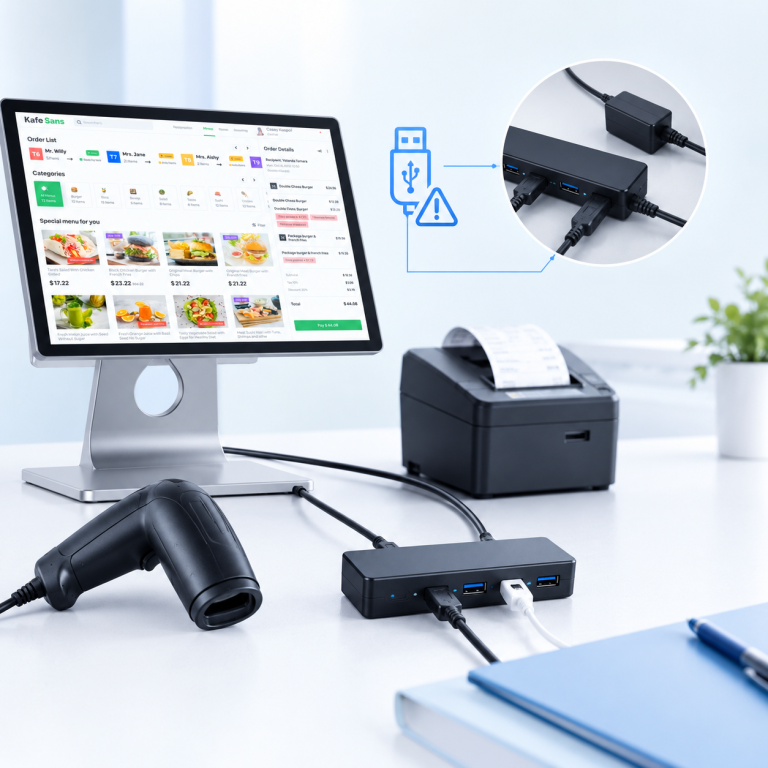 A Simple USB Hub Test for POS Device Disconnections
 Why Is Your POS Cash Drawer Not Opening
 Why Is a Thermal Receipt Printer Printing Blank Receipts