


Categories
- News (236)
- Support (262)
- OEM & ODM (10)
- Drivers & Tools (10)
- Instructions (29)
- Troubleshooting (44)
- Knowledge (97)
- Maintainance (8)
- Blog (90)
Previously, retail POS commercial terminals powered by the N100 processor were highly favored for their cost-effectiveness, while those equipped with Intel’s newer N97 processor became more and more popular for their superior stability. A customer recently asked Sunany about the differences between the N97 and N100 processors. Let’s take a look today!
Both Intel processors N100 and N97 are entry-level CPUs in the Alder Lake-N series. The N100 processor offers 4 of the 8 efficiency cores (E cores, Gracemont architecture) with a frequency of 1GHz to 3.4GHz. The N97 processor also offers 4 of the 8 efficiency cores, with a base frequency of 2.00 GHz and a maximum turbo frequency of 3.6 GHz.
Processor frequency indicates how quickly the CPU executes instructions. The higher turbo frequency of the N97 processor means it can handle high-demand tasks more efficiently than the N100 processor. However, for basic POS operations like routine cashiering, the performance difference between these processors may not be noticeable. But if it runs at a high load for a long time, the N97 processor may have an advantage over the N100 processor.
The processor has more graphics units, which allows the retail POS commercial terminal to display product information or promotional advertisements more smoothly and clearly. Alder Lake-N integrates Xe-based graphics units with up to 32 EUs (execution units). Among them, 24 are activated in the N100 processor, and the main frequency is relatively low, at 450-750MHz. Although the N97 processor also only activates 24, the main frequency is as high as 1200MHz.
It makes the retail POS commercial terminal powered by the N97 processor better suited for businesses that require rapid switching of product categories or connecting to digital signage. In contrast, the retail POS commercial terminal powered by an N100 processor is ideal for small retailers with modest graphic processing needs who prioritize energy efficiency.
In terms of interface scalability, both the N97 processor and the N100 processor support multiple interface protocols, such as PCIe, USB interface, and serial port RS232, which can allow retail POS commercial terminals to be well connected to peripheral devices such as barcode scanners, printers, and payment terminals.
If the retail POS commercial terminal is used to process our daily cashier work, play advertising videos, record sales data, etc., the N97 processor and N100 processor are both actually good choices. Sunany’s F200 retail POS commercial terminal and the new E-series retail POS commercial terminal offer solutions powered by both the N97 and N100 processors. We are happy to recommend the most cost-effective solution based on your specific needs.
 DDR4 vs. DDR5 for POS Software: Which Is the Better Choice?
 Before a POS SSD Replacement, Prepare the Software Restore
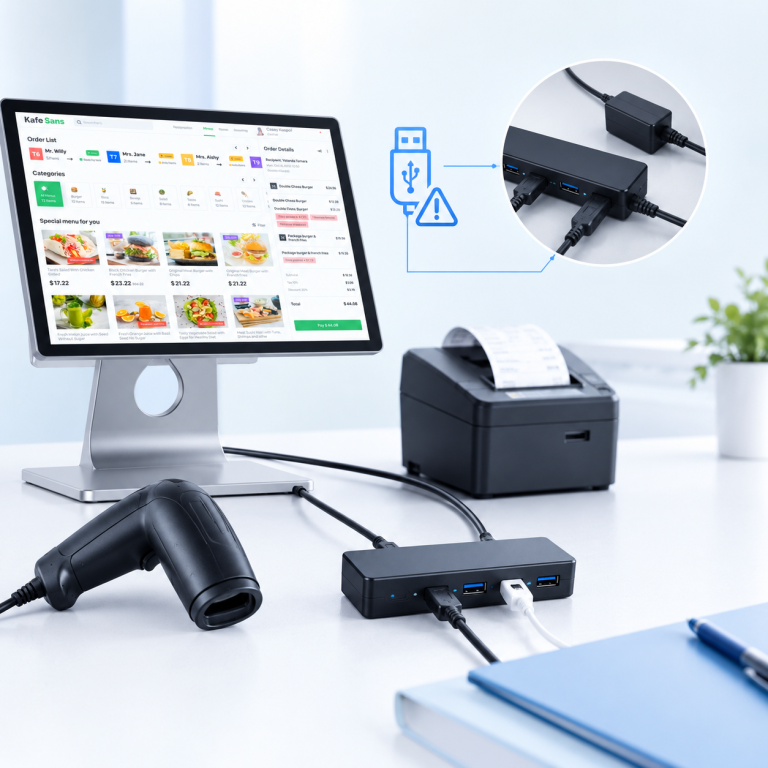 A Simple USB Hub Test for POS Device Disconnections
 Why Is Your POS Cash Drawer Not Opening
 Why Is a Thermal Receipt Printer Printing Blank Receipts