


Categories
- News (236)
- Support (262)
- OEM & ODM (10)
- Drivers & Tools (10)
- Instructions (29)
- Troubleshooting (44)
- Knowledge (97)
- Maintainance (8)
- Blog (90)
RFID and barcode readers are two important peripherals of POS machines. They have their own unique technical advantages and play an important role in helping POS machines to identify goods and manage inventory and checkout processes. We know that RFID mainly identifies RFID tags, while barcode readers mainly identify barcode labels. Let’s follow Sunany to see what the difference is between RFID tags and barcode labels today.
First of all, in terms of working principle, RFID tags use radio frequency communication to transmit data. A microchip and an antenna are built into the tag. When the RFID tag enters the radio frequency range of the RFID reader, the tag’s antenna will receive the radio frequency signal from the RFID reader and activate the chip. The chip then sends the stored data back to the reader through the antenna, making RFID technology faster and more accurate.
The working principle of barcode labels is relatively simple, mainly relying on optical technology for data reading. Barcode labels represent different sequences of numbers and letters through black and white stripes or rectangular patterns of different widths. When the barcode reader scans the barcode label, the reflected light is converted into an electrical signal in the barcode reader, so that the information can be accurately read. It means that RFID technology can achieve contactless reading and remote identification, while barcode technology requires physical contact and a straight line of sight.
RFID electronic tags and barcode labels also differ in the way they are read. RFID electronic tags have a faster reading speed and can read multiple tags at the same time within seconds. There is no need to scan products one by one, which means that customers only need to place the purchased products next to the RFID reader of the POS machine, and all product information can be read and settled instantly, which is very suitable for supermarkets with large customer traffic.
barcode labels can usually only be scanned one by one, and the scanning speed and efficiency are affected by the cashier’s proficiency and the clarity of the barcode label, which is prone to scanning errors or delays. However, due to its low cost, it is a good choice for retail stores with small customer traffic.
Although RFID electronic tags and barcode labels are both important automatic identification technologies, there are certain differences between them. In order to make it easier for customers to use peripherals, Sunany provides easy ports at both ends or one end of the POS machine to directly install easy devices (RFID readers, barcode readers) in a short time, thereby greatly improving the operational efficiency of supermarkets and retail stores.
 DDR4 vs. DDR5 for POS Software: Which Is the Better Choice?
 Before a POS SSD Replacement, Prepare the Software Restore
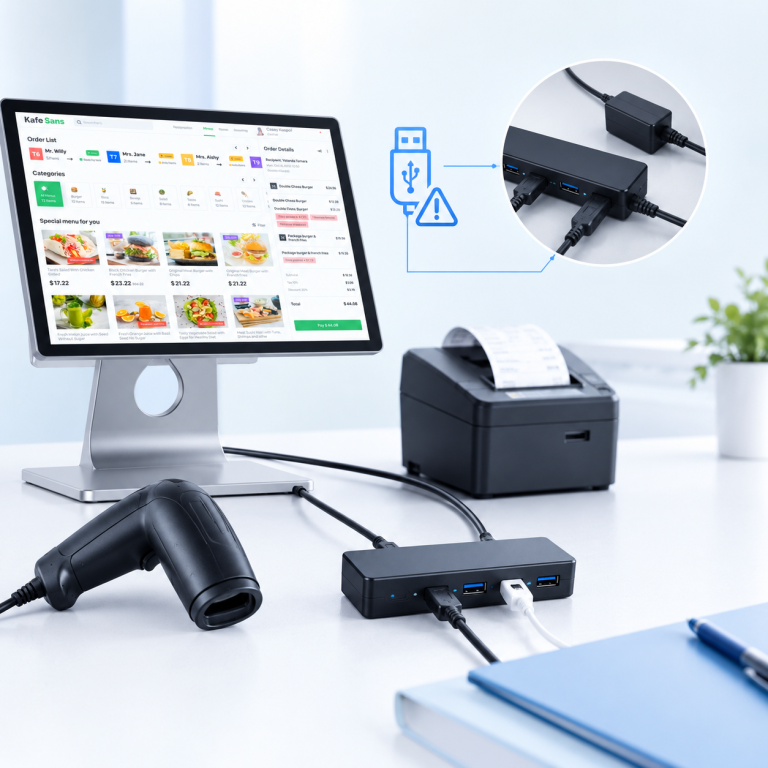 A Simple USB Hub Test for POS Device Disconnections
 Why Is Your POS Cash Drawer Not Opening
 Why Is a Thermal Receipt Printer Printing Blank Receipts